Word of the Day: microsaccade
Microsaccades are tiny, involuntary quivering movements of the eyes. The constant motion tends to vary the stimuli to the retina so the rods and cones don't tire out and stop firing (known as Troxler fading).
To observe them, stare at the center of the red dot for 15 seconds, then stare at the blue dot. You should see a jiggling afterimage.

Saccades (from the French word for "twitch") are the larger movements your eyes make as you read or take in a scene, jumping from point to point. Vision is far better in a small region in the middle of the retina called the fovea, so the eye scans around to take it all in. These are apparently the quickest movements in the body.
There are plenty of other fun facts about eye movement out there and lots of cool words. Extorsions and intorsions are rotations around the axis of vision, something I did not know the eye was capable of. (Sure enough, if I look at my eye in the mirror and rotate my head to one side, the eye rotates toward level.) Optokinetic nystagmus is the tendency to track individual items in a moving stream, like a stock ticker, and jump from one to another. Smooth pursuit allows you to lock on and follow an object moving at constant speed. Easy enough, but it can't be done without the object to track. Try sweeping your eyes in a smooth circle while looking at a blank wall.
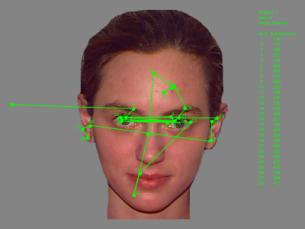
One more image - the scan pattern of a person looking at a face.
Further reading:
Types of eye movements (try the demonstration of Troxler fading with the orange circles)
Gaze control in face perception
Short list of eye movements with graphs of movement speeds and the moment of blindness that occurs during a saccade
To observe them, stare at the center of the red dot for 15 seconds, then stare at the blue dot. You should see a jiggling afterimage.
Saccades (from the French word for "twitch") are the larger movements your eyes make as you read or take in a scene, jumping from point to point. Vision is far better in a small region in the middle of the retina called the fovea, so the eye scans around to take it all in. These are apparently the quickest movements in the body.
There are plenty of other fun facts about eye movement out there and lots of cool words. Extorsions and intorsions are rotations around the axis of vision, something I did not know the eye was capable of. (Sure enough, if I look at my eye in the mirror and rotate my head to one side, the eye rotates toward level.) Optokinetic nystagmus is the tendency to track individual items in a moving stream, like a stock ticker, and jump from one to another. Smooth pursuit allows you to lock on and follow an object moving at constant speed. Easy enough, but it can't be done without the object to track. Try sweeping your eyes in a smooth circle while looking at a blank wall.
One more image - the scan pattern of a person looking at a face.
Further reading:
Types of eye movements (try the demonstration of Troxler fading with the orange circles)
Gaze control in face perception
Short list of eye movements with graphs of movement speeds and the moment of blindness that occurs during a saccade